Replenishment
Summary
This screen is used to assist in replenishment of stock within the business. it summarises a variety of information, then collates that to produce a recommended quantity to order/transfer.
It must be filtered by Store and Supplier in order to work, but may also be filtered to view suggested only, which will remove any Products which do need need to be ordered.
This is an automated process, and relies on general rules; it is important to review the recommendations manually.
Field Summary
It is possible to filter to an 'aggregated view' - for more information, click here.
| Field | Purpose |
| Dated figures (e.g. preceding and succeeding months, as well as last 12 months and month to date) |
These columns include the sum of all stock despatched from the selected Store, as well as all stock in locations in that Store which is currently reserved to Sales orders, no matter the selling Store.
That means:
|
| Available Stock | This shows the amount of stock currently available within the selected Store |
| Available for Replenishment |
This shows the amount of stock currently available for replenishment within the selected Store
To be eligible for replenishment, that stock must be available, and the Store must be marked as enabled for replenishment |
| Stock Pending Transit |
This shows stock currently in transit to this Store
This will include all units of stock be on a Stock Transfer which is 'in transit', and any outstanding units of stock on Stock Transfer which is 'Received (In Progress) |
| Stock on Order | This shows stock currently on a Purchase Order, which is being delivered to the selected Store |
| Required for Orders | This shows stock required for sales orders where the selling Store is the currently selected Store |
| Low Stock (order at) |
This shows the Low Stock figure
This is set against the Variant |
| High Stock (order to) |
This shows the High Stock figure
This is set against the Variant |
| Last Order | This shows the date of the most recent Purchase Order for each Variant, as received by the selected Store |
| Suggested qty to order |
This shows a recommended quantity to order, based on the data in this report; this may either be in the form of:
|
How does it work?
The page reviews recent sales against over the previous 12 months. This produces an average daily sales rate, and uses the days elapsed since the last Purchase Order for that SKU (or 12 months, whichever is longest) to produce a 'suggested quantity to order'.
This will also take into account the Order At and Order To figures, if they have been set on the Inventory tab when editing a Product.
Actioning a Recommendation
To action a line, select it using the tick box to the right of the screen. Once you have selected all which are required, use the 'order selected lines' button at the bottom of the page. This will then either create Stock Transfers or Purchase Orders as necessary.
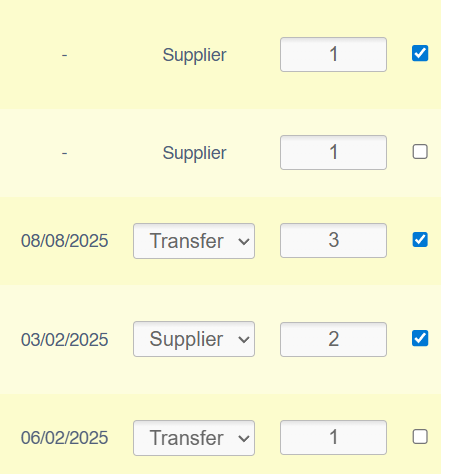
Transfers
These will be created if 'Transfer' is selected. This will be prioritised if there is free stock elsewhere in the business.
This will not be available if no other stock exists within the business.
Purchase Orders
These will be created if 'Supplier' is selected.
Mark Lines as Not Required
This should be used to hide a line. Select Products that you do not wish to be recommended by ticking them, and then 'mark lines as not required'.
If you filter the screen to 'suggested only', these Products will be hidden.
This should be used for end of line items that are being retained for reporting purposes.
FAQs
My Product is not showing in this report - why?
There are two main reasons why a Product will not show in the Replenishment report:
- It has been marked as 'not required' (see above)
- It is a 'Made to Order' Product
What happens if I attempt to Transfer more stock than is On Hand?
In this instance, a Stock Transfer will be created for the maximum quantity of stock. For the remainder, a new Purchase Order will be created. E.g. there are 5 units on hand, and you Transfer 8. 5 will be added to a Stock Transfer, and a new Open Purchase Order will be created for the remaining 3.
What happens if I need to Transfer Stock, but it is coming from multiple locations in the same Store?
The system will draw draw units of stock from multiple items onto the same Stock Transfer, so long as they are coming from the same Store.
Aggregated Replenishment
When handling Replenishment, it is possible to select an 'aggregated Store'.

This will aggregate figures for the Store, along with any other Store that uses it as a default receiving Store (See Stores for more information on this).
The way this works is as follows:
- Store A is set up to automatically receive its won POs
- Store B is set up with Store A as its 'default receiving store'
- Store C is set up with Store A as its 'default receiving store'

Stores A, B and C can be shown independently, or Store A can be shown in 'aggregated' view. If so, the Replenishment screen will retain the same layout, but the data will change.
Field Summary
It is possible to filter to an 'aggregated view' - for more information, click here.
| Field | Purpose |
|
Dated figures (e.g. preceding and succeeding months, as well as last 12 months and month to date)
|
This data is aggregated
These columns include the sum of all stock despatched from the selected Store and dependant Stores, as well as all stock in locations in that Store and its dependant Stores, which is currently reserved to Sales orders, no matter the selling Store.
That means:
|
| Available Stock |
This data is not aggregated
This shows the amount of stock currently available for replenishment within the selected Store only |
| Available for Replenishment |
This data is not aggregated
This shows the amount of stock currently available for replenishment within the selected Store only
To be eligible for replenishment, that stock must be available, and the Store must be marked as enabled for replenishment |
| Stock Pending Transit |
This data is aggregated
This shows stock currently in transit to this Store or one of its dependant Stores
This will include all units of stock be on a Stock Transfer which is 'in transit', and any outstanding units of stock on Stock Transfer which is 'Received (In Progress). |
| Stock on Order |
This data is not aggregated
This shows stock currently on a Purchase Order, which is being delivered to the selected Store only |
| Required for Orders |
This data is aggregated
This shows stock required for sales orders where the selling Store is the currently selected Store or one of its dependant Stores |
| Low Stock (order at) |
This data is not aggregated
This shows the Low Stock figure
This is set against the Variant |
| High Stock (order to) |
This data is not aggregated
This shows the High Stock figure
This is set against the Variant |
| Last Order |
This data is not aggregated
This shows the date of the most recent Purchase Order for each Variant, received at the current Store |
| Suggested qty to order |
This data is aggregated - this will take into account stock used in all linked Stores
This shows a recommended quantity to order, based on the data in this report; this may either be in the form of:
|
How does it work?
Aggregated Data
- Sales Data will be aggregated for sales across Stores A, B and C
- Stock Data will be aggregated across Stores A, B and C - this includes:
- Available Stock
- Available for Replenishment
- Stock Pending Transit
- Stock On Order
Data That is Not Aggregated
Some data is not aggregated:
- Required for Orders (this is Store specific, and is managed via the Required Orders screen)
- High/Low stock figures (these are Store specific, and in aggregated view, default to just the selected Store only)